Spanish III - Learning Options
Filter
5 Products
5 Products
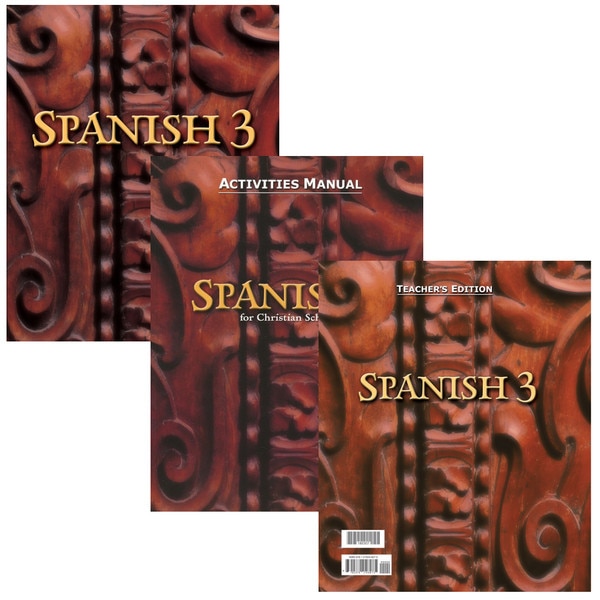
Spanish III - Learning Options
This course serves as a transition point, pushing students to read and write in Spanish significantly more. Students also focus on Spanish in its historic and modern cultural context so that they can better communicate with native speakers.
Format: See Tabs Below
SPANISH III IS A YEAR-LONG COURSE FOR STUDENTS IN GRADES 9-12.
In Spanish III, students will increase and reinforce the grammar elements learned in previous years by expanding their knowledge of verb tenses, continue to build vocabulary, and improve their conversational ability in a variety of settings. This course serves as a transition point, pushing students to read and write in Spanish significantly more. Students also focus on Spanish in its historic and modern cultural context so that they can better communicate with native speakers. Spanish III is available in Live Online format.
The Veritas Approach to Modern Foreign Languages
The old joke asks, “What do you call someone who speaks three languages?” Trilingual. “Someone who speaks two?” Bilingual. “And what do you call someone who speaks only one?” American.
The joke works because it pokes fun at a deficiency in American education. Many believe there’s no use, no benefit, to learning more languages than one—English. Veritas aims to dispel that notion and retire the crack’s humor. Those who receive a Veritas education will never be the butt of that joke.
Students study a modern foreign language (MFL) for different reasons.
- Some want to understand the people and customs of the foreign place where they live. Missionaries to Tanzania may want their children to learn Swahili. A family stationed in Okinawa believes they’ll fit in better if they learn a little Japanese.
- Others learn an MFL to befriend and do business with those who don’t speak their language. America is a melting pot of peoples. One way of welcoming an Ethiopian immigrant is to pick up a few Amharic phrases. Learning some Vietnamese may win a smile from the restaurateur where you eat lunch.
- Still others want to learn an MFL to sharpen their mind and improve brain function. All foreign languages have sounds ours don’t. Most use a writing system ours doesn’t, either. Learning a different language calls for attention, memorization, analysis, and creativity. It gives the mind a workout.
- Some want to expose themselves to ideas as first expressed in another language. A literature student wants to experience the Spanish of Cervantes. A philosophy student wants to read Pascal in the original French. A physics student wants to tackle the German of Einstein’s thought.
- And colleges want to see at least two years of the same MFL on a transcript.
All these reasons are valid; all have their place.
The world’s home to about 7,000 languages. Like any education that teaches modern foreign languages, Veritas has to be selective. We currently offer courses in four key languages: Spanish, French, German, and Mandarin.
Each has a rich history. Each will be useful for years to come. German, French, and Spanish are “founding languages” of the modern West. Mandarin hails from China, and about a billion call it their native tongue.
Regardless of why someone learns an MFL, doing so enriches both the student and the world. Learning another people’s language is learning something about them. And learning about them can lead to better communication and greater understanding.
We recommend students study MFLs after they’ve had Latin and, hopefully, some Greek. Consequently, most Veritas students are taking MFLs in their high school years.
Veritas wants to equip students to exchange ideas with others. When we can communicate in another’s language, we’ve removed a barrier to understanding. If we can do that, we may be able to make the world a little more peaceful place. And that aim is nothing to laugh at.



HOW TO TEACH MODERN FOREIGN LANGUAGES
Watch the videos below to learn how to teach this subject!
Spanish 3 - BJU - Activities Manual
In Spanish 3, further develop students' mastery of vocabulary, oral communication skills, and grammatical structure with a special focus on verb forms. The text features true stories and letters from missionaries in Spanish-speaking countries.
Spanish 3 - BJU - Teacher Edition
In Spanish 3, further develop students' mastery of vocabulary, oral communication skills, and grammatical structure with a special focus on verb forms. The text features true stories and letters from missionaries in Spanish-speaking countries. The Teacher's Edition contains the student pages with marginal notes.

Spanish 3 - BJU - Student Text
In Spanish 3, further develop students' mastery of vocabulary, oral communication skills, and grammatical structure with a special focus on verb forms. The text features true stories and letters from missionaries in Spanish-speaking countries. The Student Text teaches the language as well as the culture.
Spanish III - Course Kit
Spanish III - Live Course Kit contains the materials each student will need to take the Veritas Scholars Academy live course.
Spanish III - Live Online Course
In this Live Online Course students will build on the grammar elements learned in Spanish II, increase and reinforce their knowledge of verb tenses, continue to build vocabulary, and improve conversational ability in different settings.