Physical Science Novare - Learning Options
Filter
4 Products
4 Products
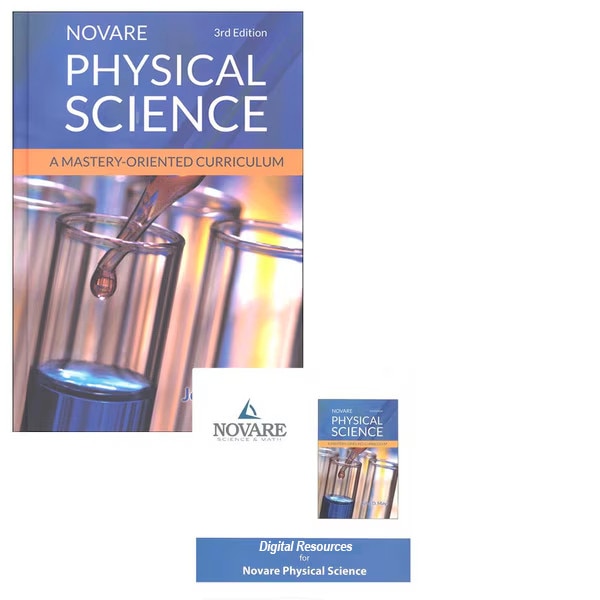
Physical Science Novare - Learning Options
Physical Science is the study of the inorganic, or non-living world, and serves as an introductory course for physics and chemistry. Basic concepts of planet earth are covered, including the atmosphere, hydrosphere, major geological formations, weather, as well as the basics of an atom, Newton's laws, and other forces in our world.
Format: See Tabs Below
PHYSICAL SCIENCE IS A YEAR-LONG COURSE FOR STUDENTS IN GRADES 7-12.
Physical Science is the study of the inorganic, or non-living world, and serves as an introductory course for physics and chemistry. Basic concepts of planet earth are covered, including the atmosphere, hydrosphere, major geological formations, weather, as well as the basics of an atom, Newton's laws, and other forces in our world. Hands-on experiments will make use of simple household chemicals and supplies. Your student need not anticipate becoming an astronomer or geologist to appreciate the engaging details of God’s Creation presented in this course. Physical Science is offered in both You Teach and Live Online formats.
The Veritas Approach to Science
“I’m not a science person.” If science teachers banked a dollar every time they heard it, they could retire after five years. Many students feel they lack the gene or the gift or whatever it takes to succeed in science. They’ve bought the piece of fiction that science isn’t for everyone.
“Science involves a lot of math,” they reason, “and I’m not a math person.” “Science isn’t important for what I want to do in life.” “Science is incompatible with my faith.” “Science isn’t for the imaginative, the verbal, or women, and I’m all three.” Each sentiment may be understandable. Each reveals an incomplete or inaccurate picture of what science is, though.
Veritas has a different view of science. We see it as the cultivation of a skillful inquisitiveness about the natural world. We see it as applying to all of us, as well. We believe that science, as a field of study, primarily involves discovering the timeless, universal principles God has built into His creation. Therefore, we teach students not only the facts and principles already discovered by past generations, but also the carefully executed processes that have made these facts and principles known. We also seek to cultivate and encourage an attitude of wonder and curiosity. Science is a means of delving into Almighty God's handiwork, and it should naturally inspire us all.Aristotle said that human nature compels us all to want to know about ourselves and the world around us. Part of what makes us different from dogs, fish, and flowers is our appetite for answers. Why does the sky look blue but space black? Where did the dinosaurs go? Why are there no pain receptors in the brain? Why are there so many languages in the world? Why aren’t there more chocolate chips in this cookie?
We can no more opt out of our inclination to learn new things than we can choose never again to breathe, sleep, or dream. Desiring to know doesn’t so much describe what we do as who we are. Our curiosity percolates from the core of our being.
By nature, we explore, observe, theorize, hypothesize, test, and revise. We go for curiosity’s sake where we’ve never gone before. We note, describe, and measure what we see, hear, touch, taste, and smell. We build mental models to explain our experiences. We later replace those models when better ones come. When we’re doing all these things, we’re doing science.
Veritas believes that everyone is a science person. Some prefer art and music to biology, chemistry, and physics, true. Others enjoy the life and physical sciences and do well in them with little effort. This is true, also. No two of us have identical strengths and skills. Still, God has fashioned each of us to be a science person.
The sciences can enliven the mind as much as any humanities course. They can describe, model, and predict natural phenomena. They can open our eyes to see the world in new ways. They can help us solve some of mankind’s most troublesome problems.
Veritas introduces students to science’s contributions found in the Great Books, too. We teach not only science proper, but also scientific reasoning. We explore ideas that lead us to ask important questions about ourselves and the world.
We use three different curricula in our science courses. Veritas is working on a science curriculum. The first volume is Chemistry and is what we use in our live online courses. Apologia is a very homeschool friendly and covers the basics of the sciences. Novare Science is a more rigorous mastery approach. The difference being Novare covers fewer topics but goes in-depth into those that are covered. We believe either of these approaches provide a solid foundation for the classically educated student.
Grade | Recommended Courses |
7th | General Science (Apologia) or Earth Science (Novare) |
8th | Physical Science |
9th | Biology |
10th | Chemistry |
11th | Physics I |
12th | Anatomy & Physiology, Advanced Chemistry, Marine Biology, Organic Chemistry, or Physics II |
It’s notable that Veritas does not recommend science in grammar school. As you should see, not because we think science unimportant. Rather, we know time is limited, and building the language and math foundation is more important. And we’ve seen it time and time again because we’ve produced some great scientists. Students with no grammar school science may start a bit behind their peers who’ve had science, but very quickly pass them in their science learning. Of course, Veritas recommends and includes memorizing a whole host of science facts in Memory Period of grammar school.
Some believe the sciences have little to offer a classical Christian education. Veritas aims to dispel that notion. We humans are a curious lot at heart, brimming with questions. Science can’t answer them all, but it can give us powerful tools for seeking those answers out.



Novare Digital Resources for Physical Science
The Digital Resources for Novare Physical Science provide everything you need to effectively plan, organize, and assess this course—whether in a homeschool, co-op, or classroom setting. All materials are fully printable and may be distributed to your students, with just one purchase required per household or classroom.
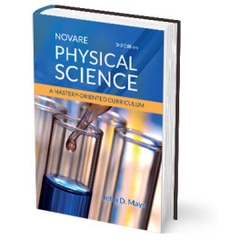
Physical Science - Novare - Student Text
Designed for grades 6-8, this physical science course combines mastery, integration, and Kingdom perspective to draw students into scientific inquiry and break the cram-pass-forget cycle to truly learn and retain course material. The Novare Physical Science Student Text goes deep with a...
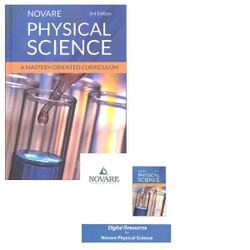
Physical Science - Novare - Course Kit
Designed for grades 6-8, this physical science course combines mastery, integration, and Kingdom perspective to draw students into scientific inquiry and break the cram-pass-forget cycle to truly learn and retain course content. The Novare Physical Science You Teach Kit includes the 3rd ...

Physical Science Novare - Live Online Course
Our Novare Physical Science course exercises minds while establishing foundational science skills. Using the Novare curriculum, students develop skills in mathematics, English, and measurement.